- A real 10-contract GLD put spread: sold the $360/$350 for $1.06 on Oct 6, when the $360 strike sat just under a support area GLD had held for a year.
- GLD broke support and my strike on Oct 30. I waited for follow-through, then rolled to Nov 20 at the same strikes for a $0.66 credit.
- Two days later the market rallied and I closed at 50% of the $1.72 I’d collected: +$860, before commissions.
A volatile month for gold
Gold came into October already shaken. On September 28, GLD fell 3.94% in a single day as the 10-year Treasury yield closed near 5.24%, a level last seen in 2007. By then the fund was about 26% below its 52-week high of $509.70.
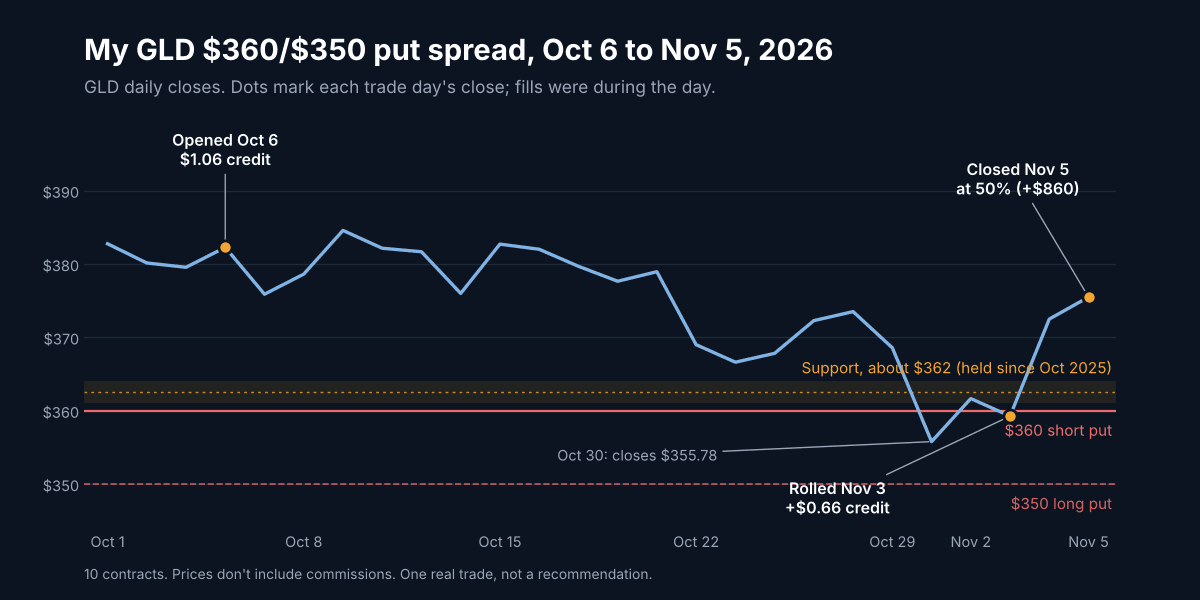
October didn’t calm down. GLD’s daily moves went −1.67%, +1.57%, −1.49%, +1.79%, −2.63%, and on the last day of the month, −3.47%. It closed October at $355.78. Four trading days later, on November 5, it closed at $375.49, up 5.5% from that low.
I had a put credit spread on GLD through all of it.
The two terms you need first
A put credit spread is two puts on the same stock and expiration. You sell one put and buy a cheaper one at a lower strike. You collect a credit up front, and the put you buy caps your loss. If the stock stays above the higher strike until expiration, you keep the whole credit.
Rolling means closing the spread you have and opening a new one further out in time, in one order. I only roll when I can do it for a net credit, to the same strike or a lower one.
The trade: October 6
On Monday, October 6, at 9:52 AM, I opened 10 GLD put spreads expiring November 6, 31 days out:
| Sold | $360 put | $2.20 |
| Bought | $350 put | $1.14 |
| Credit | $1,060 for 10 contracts | $1.06 |
GLD closed at $382.27 that day, so my short strike sat about 5.8% below the price. The most I could lose was the $10 width minus the $1.06 credit: $8.94 a share, or $8,940 for 10 contracts.
Before I sell any put or put spread, I run the same checks. Five every time:
- No earnings report before expiration. GLD is a gold ETF, so there is none.
- A low delta. The $360 put passed.
- The strike outside the expected move. It passed.
- A tight bid/ask spread. GLD options are among the most traded in the market.
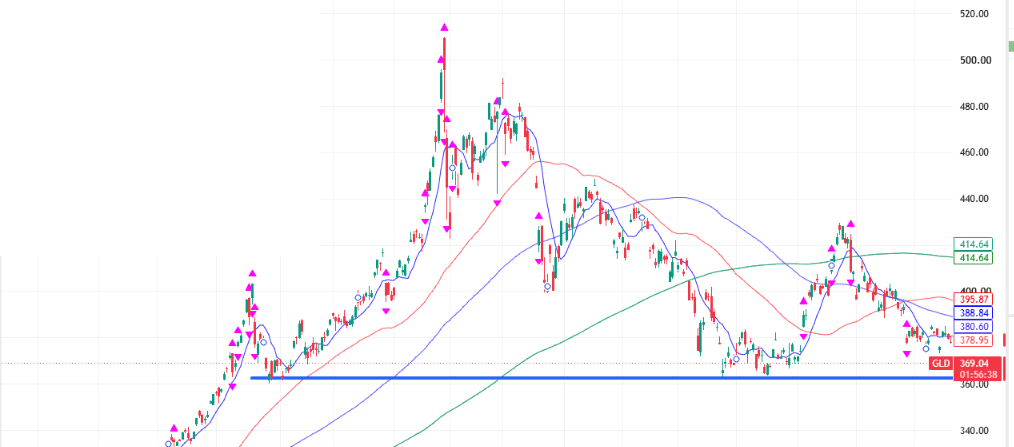
- Last Touch: GLD hadn’t closed at or below $360 in 271 trading days, since October 3, 2025.
Then one of two: the stock is above its 100- and 200-day moving averages, or there’s a support zone above the strike. GLD was below both averages, so the trend check didn’t pass. Support decided it. GLD had bounced off the same area, around $362, several times since October 2025, and my $360 strike sat just below it.
I explain each check in Before you sell a put: 5 checks every time, plus 1 of 2.
October 30: GLD breaks support, and my strike
GLD drifted lower through October, and on Friday, October 30, it fell 3.47% and closed at $355.78. That’s $4.22 below my $360 short strike, with one week left. It didn’t just go below my strike. It broke through a strong support area.
I didn’t panic. I followed my rules, the ones in Hold, close or roll?:
- Has something changed about what I own? Nothing had. The sharp drop came from a broad market sell-off, not from anything about gold itself.
- Would I still be comfortable owning it at my strike? Yes. Nothing about gold had changed.
- Can I roll for a credit or breakeven, to the same strike or a lower one, with no earnings before the new date, and fewer than two monthly rolls so far? This would be my first roll, and GLD has no earnings.
So I didn’t act that Friday. I wanted to see whether the selling would follow through.
November 2–3: back to support, then through it again
On Monday, November 2, GLD settled back at the support area, closing at $361.65. On Tuesday it broke through again.
With the market this volatile, I wanted to give the trade more time. On Tuesday, November 3, at 10:19 AM, three days before expiration, I rolled all 10 spreads to November 20 at the same strikes, for an additional credit. Rolling to a lower strike for a credit wasn’t available.
| Closed | Bought back the Nov 6 $360 put | $3.82 |
| Closed | Sold the Nov 6 $350 put | $0.95 |
| Cost to close | $2.87 | |
| Opened | Sold the Nov 20 $360 put | $7.05 |
| Opened | Bought the Nov 20 $350 put | $3.52 |
| New credit | $3.53 | |
| Net for the roll | $660 for 10 contracts | +$0.66 |
Two things changed with the roll. I had two more weeks for GLD to get back above $360. And because the roll paid me $0.66, my total credit went from $1.06 to $1.72, which lowered my maximum possible loss from $8,940 to $8,280.
What didn’t change: the strikes. I didn’t move them up to collect more, and I didn’t pay anything to stay in the trade.
November 5: the rally, and the close
Gold turned. On Wednesday, November 4, GLD jumped 3.7% to close at $372.49. On Thursday, November 5, at 9:40 AM, I closed all 10 spreads:
| Bought back | Nov 20 $360 put | $1.48 |
| Sold | Nov 20 $350 put | $0.62 |
| Cost to close | $0.86 |
My closing rule is simple. If the market gives me 50% of the premium, or close to it, within a couple of days or a week, I take it. Over the whole trade I collected $1.72 ($1.06 + $0.66). I closed for $0.86, exactly half.
The rally brought the trade to my 50% target, and with volatility still extreme, I didn’t wait for more. I closed it.
The result
That’s $860 before commissions, in 30 days, on a trade that closed below my strike a week before expiration. Measured against the $8,940 I had at risk when I opened it, it’s about 9.6%.

Leg by leg, it wasn’t all green. Closing the first spread cost $2.87 against the $1.06 I took in, a $1,810 loss. The November 20 spread made $2,670 ($3.53 in, $0.86 out). The roll is what turned one into the other.
Looking back, holding the original spread might have worked too, since GLD was back at $375.49 by November 5. I didn’t know that on Tuesday morning, and the rule doesn’t ask me to guess.
What I’d take from it
- Size it so a bad week can’t hurt your year. I keep each trade at 5% of my account or less.
- Roll for a credit or don’t roll. Paying to stay in a losing trade is how a small problem becomes a big one.
- Same strike or lower, never higher. I could have collected more by moving the strikes up. I didn’t.
- Two monthly rolls at most, then a LEAP as the last resort. This one needed one.
- Take the 50% when it shows up. In a market moving 2% and 3% a day, a profit you can take now is worth more than the last few cents.
Before you roll to a new strike, check its Last Touch: how many trading days since the stock last closed at or below it. SpreadVector’s free Last Touch Checker shows it for any stock and strike, and a free week of scans runs every check on new puts and put spreads.
One real trade by the author, shown with every fill. Prices don’t include commissions.
Use it with the other checks
All the checks in one place: Before you sell a put: 5 checks every time, plus 1 of 2.
Quick answers
Why roll on Tuesday instead of right away on Friday?
GLD had just broken a strong support area on a broad market sell-off, and nothing about gold had changed. I wanted to see whether the selling would follow through. On Monday it settled back at support. On Tuesday it broke through again, so I rolled to give the trade more time.
Why the same strikes, not lower ones?
A lower strike for a credit wasn't available. The same strikes gave me a $0.66 credit for two more weeks, and my rule allows the same strike or lower, as long as the roll pays a credit.
Would you have rolled a second time?
Only if I could do it for a credit, to the same strike or lower, with no earnings before the new date. If not, I'd have held to expiration and accepted the loss on the spread, which the $350 put capped.
Is 10 contracts the norm?
Yes. I trade 10 contracts on about 99% of my trades.
All 5 picks every weekday at 11:00 AM ET, each with its Last Touch and why it made the list, and every screener for 7 days.
- All 5 of Today's Picks, at live prices
- 4 screeners across 800+ stocks and ETFs: Short Puts, Credit Spreads, Earnings Drift and Dividends
- Set your own delta, expiration and minimum Last Touch (10 days to a year+)
- Courses and Command Center
SpreadVector is a screening and education tool, not investment advice. This is one real trade by the author, shown with every fill; one trade says nothing about the next. Options involve risk and aren't suitable for every investor. Prices don't include commissions. Past results don't guarantee future results. GLD closes from public price history; support chart from TradingView.