- Don’t act in the first five minutes. Then ask three questions, in order: has something changed, would you still own it, can you roll for a credit?
- Roll only for a net credit or breakeven, to a lower or the same strike, with no earnings before the new date, and no more than two monthly rolls.
- If the reason you sold the put is gone, close it, even at a loss. A small loss taken early is the good outcome.
You sold a put. The checks all passed. And now, a week later, the stock is sliding toward your strike.
This is the moment most put sellers make their worst decisions: in a hurry, while the price is moving. The fix is to decide ahead of time what you’ll do. Here’s the process I use, step by step.
Start with a real setup
On Tuesday, Oct 27, 2026, one of the setups on SpreadVector’s Today’s Picks was the Capital One (COF) $180 put, expiring Dec 18:
That’s about 1.2% on $18,000 of cash in 52 days, with the strike sitting below a tested support zone near $193. You can run the same numbers on any put with the cash-secured put calculator.
A solid setup. But no setup is a promise. So say that in a few weeks COF slips toward $180, and the put you sold for $2.08 is now worth a lot more. (From here on, the prices are illustrations, not a forecast for COF.)
What do you do?
First: do nothing for five minutes
Don’t close it in a panic, and don’t roll it on reflex. A stock moving toward your strike isn’t, by itself, a reason to act. Then go through three questions, in order.
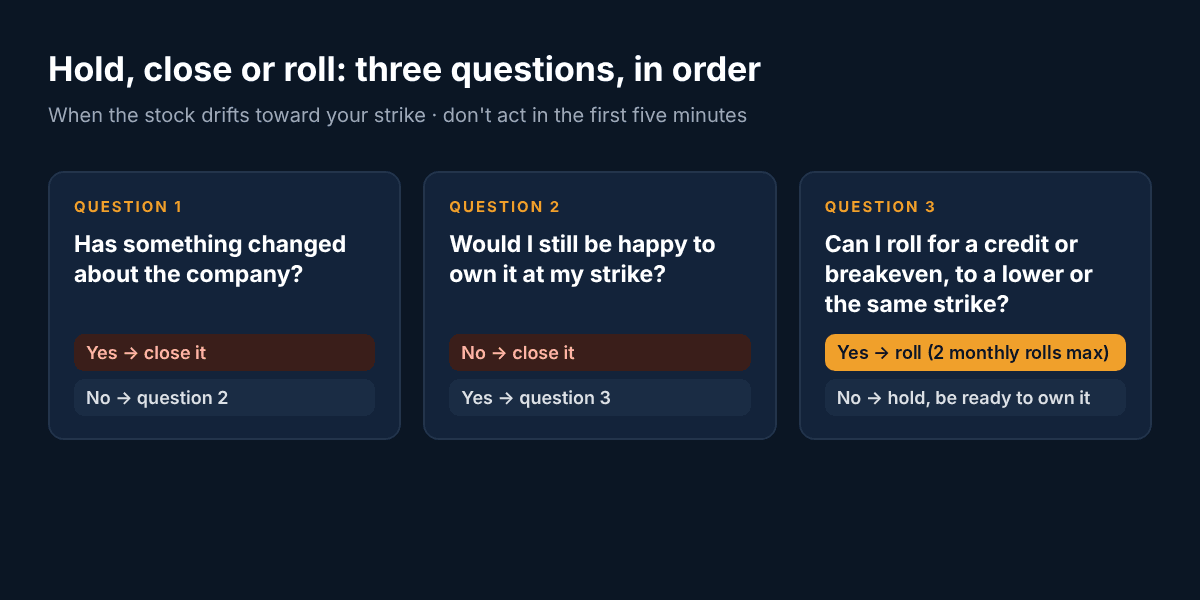
Question 1: Has something changed about the company?
News. A downgrade. A lawsuit. A broken support level. The start of a long downtrend.
If the reason you sold the put is no longer true, close it, even at a loss. You don’t owe the trade anything.
In the COF example, the support zone near $193 was part of the reason for the trade. If COF cuts straight through it on bad news, the setup you sold is gone.
Question 2: Would I still be happy to own this stock at my strike?
It’s the same question you asked before you sold the put. Ask it again, honestly. If the answer is no, close it. If it’s yes, keep going.
I only sell puts on stocks I’d be glad to own. When the answer to this question changes, so does the trade.
Question 3: Can I roll it for a net credit or breakeven?
To a lower strike (ideal) or the same strike. If yes, and you haven’t already rolled this trade a month out twice, rolling is an option. It’s what I do most of the time. After two monthly rolls, the only roll I’ll consider is my last resort, a LEAP (see the rolling rules below).
If no, hold it and be ready to be assigned. You’ll own a stock you’re happy to own, at a price you chose. That’s where the wheel strategy starts.
What rolling actually means
Rolling is one order that does two things: it buys back your current put and sells a new one, usually with a later expiration and a lower or the same strike. Done right, it buys you time and moves your strike further from the stock. Done wrong, it just postpones a loss and makes it bigger.
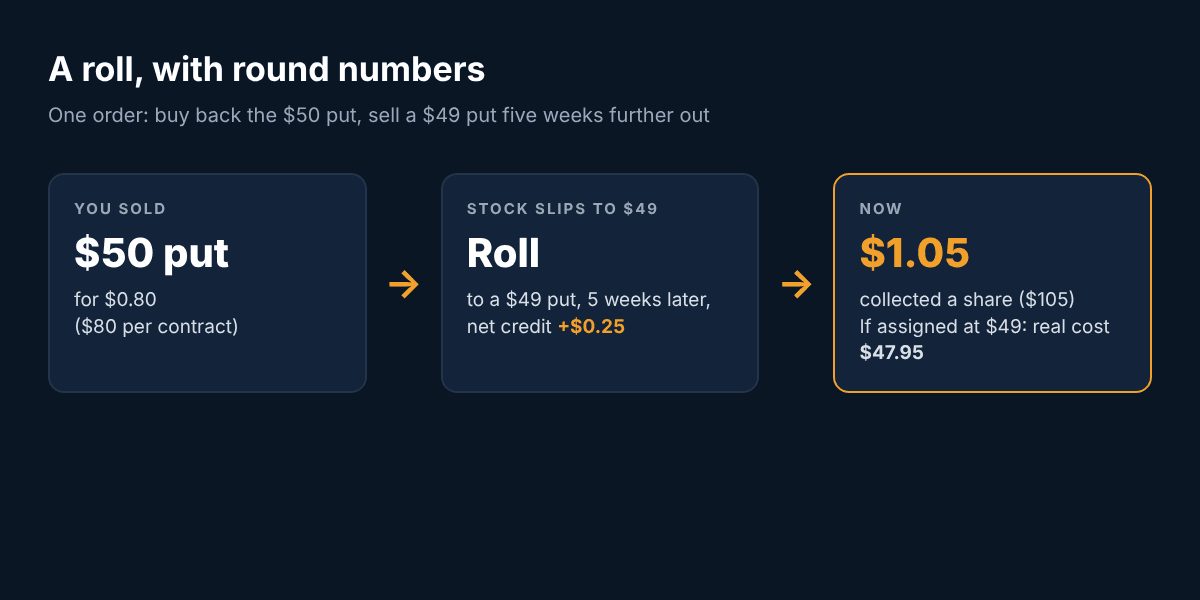
Here’s a roll with round numbers:
- You sell a $50 put for $0.80 ($80 per contract).
- A few days before expiration, the stock has slipped to $49. The put is in the money, and you’d likely be assigned.
- In one order, you buy back the $50 put and sell a $49 put five weeks further out, for a net credit of $0.25.
- Your strike is $1 lower, you have five more weeks, and you’ve collected $0.80 + $0.25 = $1.05 a share ($105 per contract).
- If you’re assigned at $49, your real cost is $49 − $1.05 = $47.95 a share.
My four rolling rules
- Only roll for a net credit or breakeven. If you have to pay to roll, you’re paying to keep a losing trade alive. If you don’t mind owning the stock, take the assignment instead.
- Roll down or to the same strike, never up. Moving the strike further from the stock is what really helps.
- Run the checks again. The new put is a new trade, so it needs the same checks as any other, above all no earnings before the new expiration. Rolling into an earnings report turns a small problem into a big one.
- Two monthly rolls at most. If I’ve rolled a trade a month out twice and the stock is still falling, the market is telling me something. I take the loss, take the shares, or, if the trade still passes my checks, make a third and final roll out to a LEAP: a long-dated option that expires a year or more away, at a much lower strike. I only do that if the new strike is below a well-defended support area and its Last Touch is more than a year, on a stock I don’t mind owning.
Rolling isn’t a rescue. It’s a way to give a good trade more room when the reasons you sold the put are still intact.
When closing is the right answer
Say you sold a $50 put for $1.00, the stock falls to $47, and the put is now worth $4.00. Closing costs you $3.00 a share, or $300 per contract. That hurts.
But if the company just announced bad news and the stock is heading for $40, holding means losing $9.00 a share instead, or $900 per contract. In that situation, closing at $300 is the good outcome.
Set your exit before you need it. A rule you write down when you’re calm beats a decision you make while the price is falling. And size every trade so one bad put can’t hurt your year: I keep each trade at 5% of my account or less.
The short version
- Has something changed? Yes → close.
- Would you still own it at the strike? No → close.
- Can you roll for a credit or breakeven, to a lower or the same strike, with no earnings before the new date and fewer than two monthly rolls so far? Yes → roll. No → hold, and be ready to own it.
Example only, not a recommendation. Today’s Picks, Oct 27, 2026. The COF prices after the setup are illustrations. Prices don’t include commissions.
SpreadVector’s Short Puts screener runs the same checks on every new put, including the Last Touch of the strike you’d roll to (try it free for a week).
Use it with the other checks
All the checks in one place: Before you sell a put: 5 checks every time, plus 1 of 2.
Quick answers
Should I roll as soon as the stock touches my strike?
No. Go through the three questions first. A touch isn't a reason on its own, and many puts recover before expiration.
Can I roll for a debit if I really like the stock?
I don't. Paying to roll means paying to keep a losing trade alive. If you like the stock that much, taking the assignment is usually the cleaner choice.
How far out should I roll?
Usually about a month, to a lower strike if you can get a credit, and always to an expiration with no earnings report before it.
How many times can I roll the same put?
Twice a month out. After that, if the trade still passes my checks, I make a third and final roll out to a LEAP, a long-dated option a year or more away, at a much lower strike below support. If it doesn't, I take the loss or take the shares.
All 5 picks every weekday at 11:00 AM ET, each with its Last Touch and why it made the list, and every screener for 7 days.
- All 5 of Today's Picks, at live prices
- 4 screeners across 800+ stocks and ETFs: Short Puts, Credit Spreads, Earnings Drift and Dividends
- Set your own delta, expiration and minimum Last Touch (10 days to a year+)
- Courses and Command Center
SpreadVector is a screening and education tool, not investment advice. Options involve risk and aren't suitable for every investor. The COF setup uses Today's Picks prices from Oct 27, 2026; later prices and the roll example are illustrations and don't include commissions.