- Delta is often used as a rough estimate of the chance an option finishes in the money. It's an estimate from today's prices, not a guarantee.
- We sell puts around 15-delta and put spreads around 10-delta.
- A higher delta pays more because the strike is closer to the stock. That extra premium is the market charging for the extra risk.
Open any option chain and the first number most traders look at, after the price, is delta. Many put sellers pick their strike by it and nothing else. It's a good starting point. It just isn't the whole story, and the number you choose decides more about the trade than the premium does.
What delta tells a put seller
Delta measures how much an option's price moves when the stock moves $1. For put sellers it's used another way too:
Delta is often used as a rough estimate of the chance an option finishes in the money. A 10-delta put works out to roughly a 10% chance it ends in the money, or about 90% that it expires worthless. A 15-delta put works out to about 85%. It's an estimate from today's option prices, not a guarantee: stocks move, and the odds change with them.
Put deltas are shown as negative numbers (−0.15). Put sellers usually drop the sign and the decimal and just say “15-delta.”
The trade-off, on a real option chain
Bank of America (BAC), about $51.73, puts expiring Nov 20 (35 days). Same stock, same date, five strikes. Per contract (100 shares):
| Strike | Delta | You collect | Cash set aside | Rough estimate it expires worthless |
|---|---|---|---|---|
| $50 | −0.30 | $74 | $5,000 | about 70% |
| $49 | −0.22 | $51 | $4,900 | about 78% |
| $48where we start | −0.155 | $34 | $4,800 | about 85% |
| $47 | −0.11 | $23 | $4,700 | about 89% |
| $46 | −0.07 | $15 | $4,600 | about 93% |
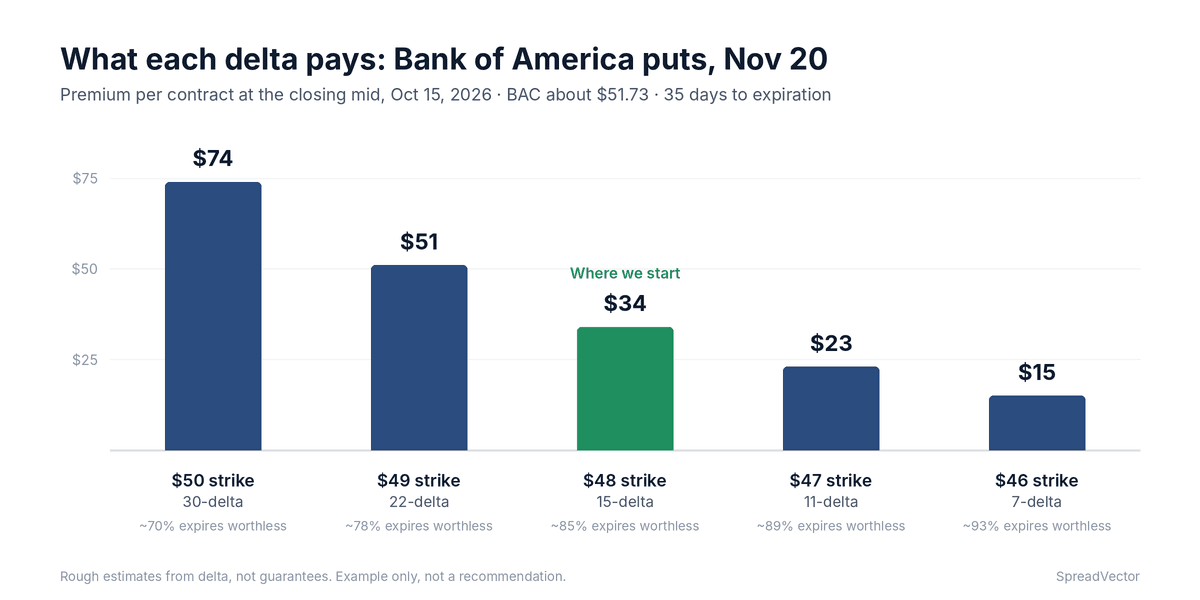
The 30-delta $50 put pays more than twice what the 15-delta $48 put pays: $74 against $34. That isn't free money. The strike is $2 closer to the stock, and the market's estimate of it ending in the money is about twice as high. Higher premium and higher risk come together, every time.
Go the other way and the premium thins out fast. The $46 put, at 7-delta, pays $15 for $4,600 of cash set aside.
Why we start at 15 for puts
- It usually sits outside the expected move. A 15-delta strike is usually below the range the options market is pricing in by expiration. A 30-delta strike is usually inside it, where an ordinary move can reach it (how to check the expected move).
- The premium is still worth it. You can go below 10-delta, but on many stocks the premium gets thin for the cash you set aside.
- Higher only on purpose. A 30-delta put makes sense mainly when you'd be happy to own the stock at that strike, because the odds of being assigned are much higher.
- It leaves room to be wrong. At 15-delta the stock can fall a fair way before your strike is in play.
I mostly sell my puts at 10- or 15-delta, never higher, unless I actually want to own the stock at that strike. I've gone below 10-delta too, but the premium does get thin.
Why spreads go lower, to 10
A put spread caps your loss, but it also caps your premium, and the gap between the two is wide.
Today's Picks on Oct 15 included a SPY $705/$695 put spread with its short strike around 9-delta: collect $43, most you can lose $957. One full loss would take about 22 winning trades to make back. When a loss is that much bigger than a win, you want the strike further away, so the short strike goes lower than it would on a put.
More real strikes from Oct 15
- Broadcom (AVGO) $305 put, Nov 13: about 15-delta, $3.33 credit, and AVGO hadn't closed at or below $305 in 142 trading days. (Today's Picks)
- Goldman Sachs (GS) $790 put, Nov 20: about 13-delta, $6.47 credit, below the expected-move range of $804.91 to $919.32. (Short Puts screener)
Example only, not a recommendation. Prices from SpreadVector, Oct 15, 2026.
What delta doesn't tell you
- It's today's estimate. Delta changes every time the stock moves. A 15-delta put can be a 40-delta put after a bad week.
- It doesn't see earnings coming. Before a report, deltas already reflect the bigger expected swing, but a gap can still jump straight through your strike. We skip puts with earnings before expiration.
- It says nothing about history. Two strikes with the same delta can have very different pasts: one the stock left 10 months ago, one it was at last week. That's what Last Touch is for.
That's why delta is one check among several, never the only one.
SpreadVector shows the delta on every Short Puts and Credit Spreads result, and the standard scan uses 15-delta for puts and 10-delta for spreads (try the full screeners free for 7 days).
Use it with the other checks
All the checks in one place: Before you sell a put: 5 checks every time, plus 1 of 2.
Quick answers
Is a 15-delta put safe?
No trade is safe. A 15-delta put has a rough 85% estimate of expiring worthless, by today's prices. That still means it ends in the money some of the time.
Why not sell 30-delta for more premium?
You can. You collect more, and you also take on about twice the estimated chance of ending in the money. It's a choice, not a free upgrade.
Does delta work the same for spreads?
Use the short strike's delta. That's the leg that decides whether the spread loses money.
Why does my broker show a different delta?
Brokers use slightly different models and prices. Small differences are normal.
All 5 picks every weekday at 11:00 AM ET, each with its Last Touch and why it made the list, and every screener for 7 days.
- All 5 of Today's Picks, at live prices
- 4 screeners across 800+ stocks and ETFs: Short Puts, Credit Spreads, Earnings Drift and Dividends
- Set your own delta, expiration and minimum Last Touch (10 days to a year+)
- Courses and Command Center
SpreadVector is a screening and education tool, not investment advice. Options involve risk and aren't suitable for every investor. All examples use SpreadVector prices from Oct 15, 2026, and don't include commissions.