- An earnings report can move a stock more in one night than it moves in the rest of the month.
- The expected move already includes the report, but it spreads it over the whole period. The real move comes all at once, usually before the market opens or after it closes.
- We skip puts with a report before expiration. Pick an expiration before the report, or wait until after it.
Most of the time, a stock gets to your strike one day at a time. You can watch it come, roll the trade or close it. Earnings is different. The company reports, and the next morning the stock opens wherever the news puts it, sometimes far below where it closed.
What happens on earnings night
Companies report before the market opens or after it closes. The stock itself may keep trading: after hours, and at some brokers, Robinhood among them, overnight too. But those sessions are thin, and prices can jump around. The put you sold doesn’t trade then. Stock options trade only during regular market hours, 9:30 AM to 4 PM ET. If the news is bad, the stock can be below your strike before you can do anything with your option, and there’s nothing to manage or roll on the way down. A stop-loss doesn’t help across a gap either: it fills at the first price available, which can be well past your level.
You can see it in the option prices
Options for an expiration that includes a report cost more, because the market is pricing the jump. Compare two expirations on the same stock, one before the report and one after.
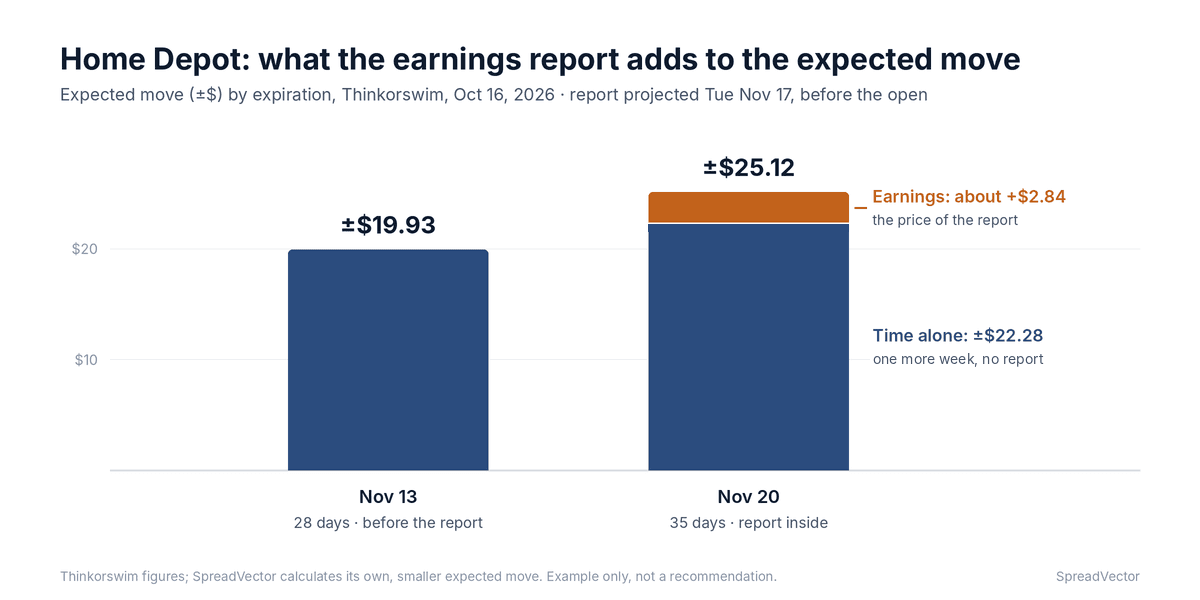
Home Depot reports (projected) on Tuesday, Nov 17, before the open. On Oct 16, Thinkorswim showed:
| Expiration | Days left | Expected move | Report inside? |
|---|---|---|---|
| Nov 13 | 28 | ±$19.93 | No |
| Nov 20 | 35 | ±$25.12 | Yes, Nov 17 |
Nov 20 is just one week after Nov 13. Without a report, that extra week would only widen the move a little, to about ±$22.28. The Nov 20 options show ±$25.12. The difference, about $2.84, is what the market is charging for the report.
Why only ±$22.28? The expected move doesn’t grow in step with time. 35 days is 25% more time than 28, but it widens the move by only about 12% (the square root of 35 ÷ 28 is about 1.12, and $19.93 × 1.12 ≈ $22.28).
These numbers are from Thinkorswim. SpreadVector calculates the expected move its own way, so its figure for the same date is smaller (±$20.87 for Nov 20). The point here isn’t the exact size. It’s the gap between two expirations measured with the same tool.
A real example: Home Depot’s $275 put
On SpreadVector’s Short Puts screener on Oct 16, Home Depot (HD) traded at $311.06. The $275 put for Nov 20 looked good on almost every check:
- Outside the expected move: the screener’s range was $290.19–$331.93, and $275 sits $15.19 below the low end.
- Delta 11: in the 10–15 zone (what delta to sell puts at).
- Last Touch: 550 trading days since HD last closed at or below $275.
- Credit $1.67 per share ($167 per contract), $27,500 set aside.
And still, the card carries a red “Earnings before expiration” tag: the report is projected for Nov 17, three days before the put expires. The standard scan hides it.
Example only, not a recommendation. Live prices from SpreadVector’s screener and Thinkorswim, Oct 16, 2026. The earnings date is projected; confirm it on the company’s investor-relations page.
“But the premium is higher”
It is, and that’s the point. The extra premium is the market charging for the gap risk. You’re not getting paid more for the same trade. You’re getting paid for a different, riskier one.
What I do instead
- Pick an expiration before the report. For HD, that’s Nov 13 or earlier.
- Or wait until after. Once the report is out, the extra premium usually drains out of the options, and you can sell with the news already known.
- The exception: if you’d be genuinely happy to own the stock at that strike, even after a bad report, selling through earnings is a choice you can make on purpose. Just make it on purpose.
I’d rather miss a good trade than hold a put through a report I can’t control.
What the earnings filter doesn’t tell you
- Dates can be projected. Until a company confirms its date, it’s an estimate. The card says “Projected” when it is.
- Funds don’t report. ETFs like SLV, GLD or SPY have no earnings, so this check doesn’t apply.
- Other news can gap a stock too: drug trial results, court rulings, an FDA decision. The earnings filter only catches earnings.
SpreadVector shows the next earnings date on every Short Puts and Credit Spreads result, and the standard scan leaves out anything with a report before expiration (try the full screeners free for 7 days).
Use it with the other checks
All the checks in one place: Before you sell a put: 5 checks every time, plus 1 of 2.
Quick answers
Is it ever OK to sell a put before earnings?
Yes, if you'd be happy to own the stock at that strike after a bad report. It's a different trade, not a forbidden one.
Does the expected move include earnings?
Yes, for any expiration after the report. That's why it's wider. But it's spread over the whole period; the report itself comes in one jump.
What about selling right after the report?
That's often the better moment: the news is out and the extra premium usually drops.
Can't I close the put after hours or overnight?
No. Stock options trade only during regular market hours, 9:30 AM to 4 PM ET (a few index ETFs, like SPY, until 4:15). Some brokers let you trade certain stocks overnight, but not the options on them.
Do ETFs have earnings?
No. Funds like SPY, QQQ, GLD and SLV don't report earnings.
All 5 picks every weekday at 11:00 AM ET, each with its Last Touch and why it made the list, and every screener for 7 days.
- All 5 of Today's Picks, at live prices
- 4 screeners across 800+ stocks and ETFs: Short Puts, Credit Spreads, Earnings Drift and Dividends
- Set your own delta, expiration and minimum Last Touch (10 days to a year+)
- Courses and Command Center
SpreadVector is a screening and education tool, not investment advice. Options involve risk and aren't suitable for every investor. The Home Depot example uses screener and Thinkorswim prices from Oct 16, 2026, and a projected earnings date, and doesn't include commissions.