- Every option has two prices. You sell near the bid and buy back near the ask, so you pay the gap twice.
- On a liquid option the gap is a few cents. On an illiquid one it can be a fifth of the premium.
- I check two numbers, the gap against the price and the open interest, and I always use a limit order near the middle.
You can pick the perfect strike and still give away a chunk of the premium before the trade even starts. It happens in the gap between the bid and the ask.
What the bid/ask spread is
Every option has two prices:
- the bid: the most a buyer is willing to pay right now;
- the ask: the least a seller is willing to accept right now.
The gap between them is the bid/ask spread. When you sell a put, you’re selling toward the bid. When you buy it back later, you’re buying toward the ask. So a wide gap costs you twice: once going in, and again coming out.
A liquid option has a tight gap, plenty of open contracts (open interest) and real trading volume. An illiquid one has a wide gap and few contracts, and the price you see isn’t really the price you’ll get.
Two liquid examples
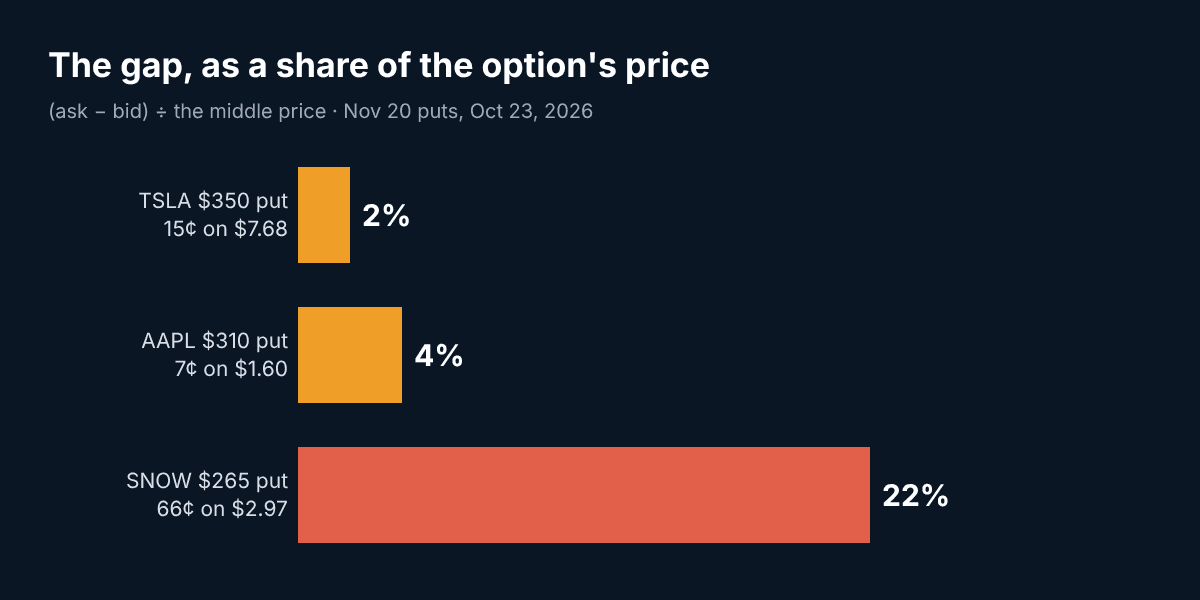
On October 23, 2026, with Tesla at $371.45, the TSLA $350 put expiring Nov 20 had a bid of $7.60 and an ask of $7.75: a 15-cent gap on a $7.68 option, about 2%. More than 10,000 contracts were open at that strike.
The same day, with Apple at $346.40, the AAPL $310 put (10-delta, same expiration) had a bid of $1.57 and an ask of $1.64: a 7-cent gap on a $1.60 option, about 4%, with more than 17,000 contracts open.
On options like these, you can sell near the middle and buy back near the middle. The gap barely matters.
An illiquid example
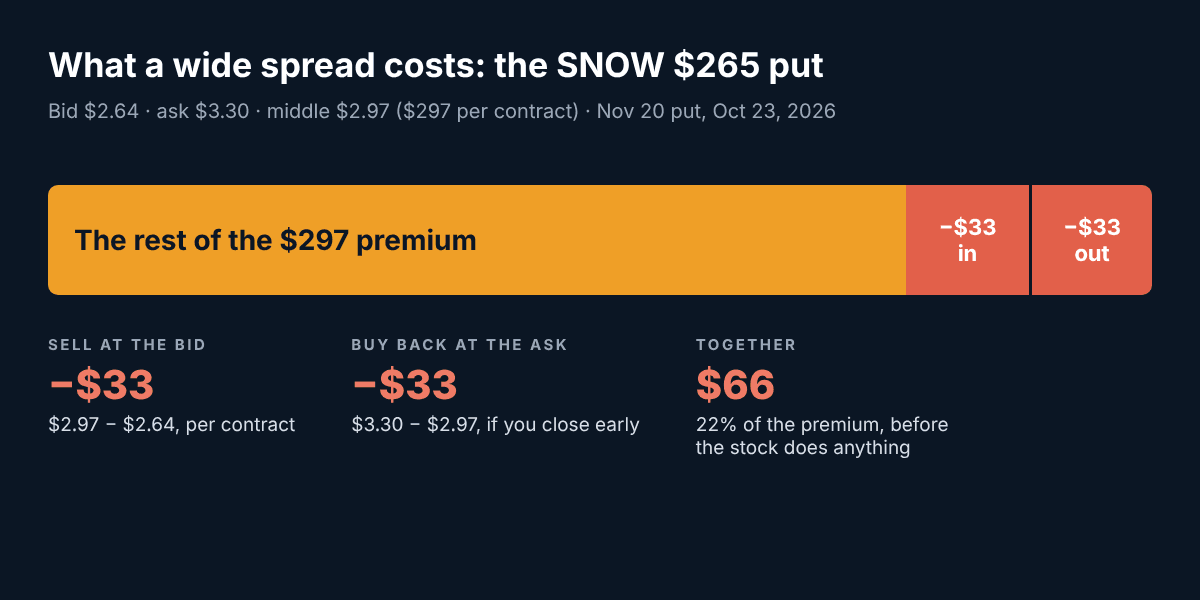
The Snowflake (SNOW) $265 put for Nov 20 had a bid of $2.64 and an ask of $3.30: a 66-cent gap on a $2.97 option, about 22%. Only 46 contracts were open at that strike.
Sell it at the bid instead of the middle and you give up about $33 per contract on the way in. Buy it back at the ask later and that’s about $33 more on the way out. Together, roughly $66, more than a fifth of the whole premium, gone before the stock does anything.
That’s why liquidity is one of my base checks. A premium that looks generous on an illiquid option often isn’t.
How I check it
- The gap against the price. A few cents on a $1 to $2 option, or under about 5% of the price, is tight. A gap of 15% or 20% of the price is a warning.
- Open interest. Hundreds or thousands of open contracts at your strike is healthy. A handful isn’t.
- Busy option markets. Big, widely traded stocks and ETFs usually have tight spreads at most strikes.
SpreadVector’s screeners show a Liquidity rating on every result (Tight, Medium or Wide), and the free scan picks liquid names first.
How I place the order
- Always a limit order, never a market order on an option. A market order fills at whatever price is there, and on a wide spread the premium you receive can be far from the middle.
- Start at or near the middle of the bid and the ask.
- If it doesn’t fill, nudge it a few cents. Don’t chase it. If the only way to get filled is to give up a big piece of the premium, skip the trade.
What liquidity doesn’t tell you
- It changes during the day. Spreads are often wider right after the open, one more reason I don’t trade the first hour.
- It says nothing about the stock. A perfectly liquid option on a stock about to report earnings is still a trade I skip (why I skip earnings).
On a put spread, it counts twice
A spread has two legs, so you cross two bid/ask spreads going in and two coming out. Check the gap on both strikes. The credit spread calculator shows what the spread is worth at the middle.
Examples only, not recommendations. Option prices from Oct 23, 2026; they change constantly and don’t include commissions.
Check any put for liquidity, earnings and Last Touch in one scan (try it free for a week).
Use it with the other checks
All the checks in one place: Before you sell a put: 5 checks every time, plus 1 of 2.
Quick answers
What's a good bid/ask spread for an option?
A few cents on a $1 to $2 option, or under about 5% of its price. Above 15% to 20%, the gap is taking a real piece of your premium.
How much open interest is enough?
Hundreds or thousands of contracts at your strike. A few dozen means few traders, and the price you see may not be the price you get.
Should I ever use a market order on an option?
No. Use a limit order at or near the middle, and nudge it a few cents if it doesn't fill.
Is a wide spread a reason to skip the trade?
Often, yes. If getting filled means giving up a big piece of the premium, the trade isn't worth it.
All 5 picks every weekday at 11:00 AM ET, each with its Last Touch and why it made the list, and every screener for 7 days.
- All 5 of Today's Picks, at live prices
- 4 screeners across 800+ stocks and ETFs: Short Puts, Credit Spreads, Earnings Drift and Dividends
- Set your own delta, expiration and minimum Last Touch (10 days to a year+)
- Courses and Command Center
SpreadVector is a screening and education tool, not investment advice. Options involve risk and aren't suitable for every investor. Option prices are from Oct 23, 2026; they change constantly and don't include commissions.