- Assignment means you buy 100 shares at the strike for each put you sold. You keep the premium, so your real cost is the strike minus the premium.
- It usually happens at expiration, when the stock closes below your strike. Early assignment is possible, but uncommon while the put still has time value left.
- After that you have three choices: hold the shares, sell covered calls above your cost, or sell the shares. Pick one before you sell the put, not after.
Every put seller gets assigned sooner or later. For a lot of people, the first time is a shock: shares show up in the account, the cash is gone, and the stock is below what they paid.
It doesn’t have to feel that way. Assignment is the promise you were paid to make. If you know what happens, what it costs and what you’ll do next, it’s just the next step of the trade.
What assignment is
When you sell a put, you agree to buy 100 shares of the stock at the strike price, any time until expiration, if the buyer of the put wants to sell them to you. You’re paid a premium up front for that promise.
Assignment is the buyer using that right. Your broker buys the shares for you at the strike, with the cash you set aside when you sold the put. That’s why it’s called a cash-secured put: the money is already there.
When it happens
At expiration. This is the usual case. If the stock closes below your strike on expiration day, even by a penny, expect to be assigned. Options that finish in the money by $0.01 or more are exercised automatically unless the owner says otherwise. You’ll usually see the shares in your account the next business day.
Before expiration. It can happen, because stock options can be exercised on any trading day. But it’s uncommon while the put still has time value, because the buyer would be throwing that value away. Early assignment on a put is most likely when it’s deep in the money with almost no time left.
Right at the strike. If the stock closes exactly at your strike, the put isn’t exercised automatically, but the buyer can still choose to. You won’t know until the next morning. That uncertainty is one reason many sellers close a put that’s near the strike before the final day.
The math: your real cost
Here it is with round numbers. One contract is 100 shares.
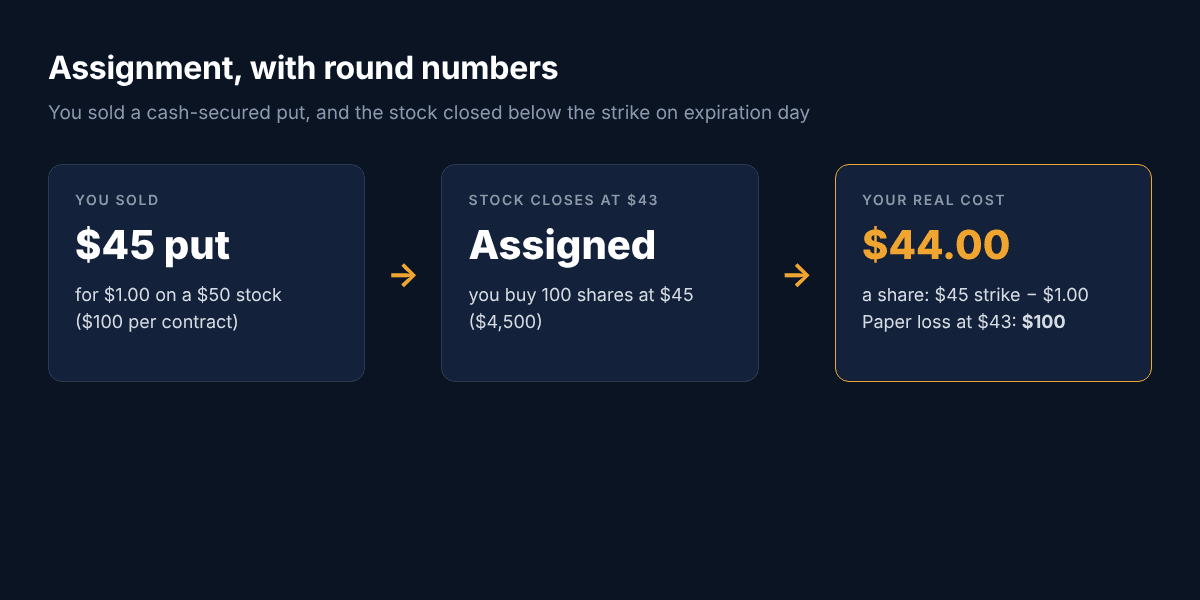
- You sell the $45 put on a $50 stock for $1.00, and collect $100.
- On expiration day the stock closes at $43.
- You buy 100 shares at $45: $4,500, from the cash you set aside.
- You keep the $100 premium, so your real cost is $45 − $1.00 = $44.00 a share.
- At $43, that’s a $100 paper loss, not the $200 it looks like if you only compare $45 to $43.
That $44 is the number that matters from here on. Every decision after assignment is measured against it. You can run your own numbers in the cash-secured put calculator.
Your three choices the morning after
1. Hold the shares. If the reason you sold the put still holds, and the company hasn’t changed, you can simply own the stock and wait. You chose this price on purpose.
2. Sell a covered call above your cost. Now that you own 100 shares, you can sell a call against them and collect more premium while you wait. Pick a strike at or above your $44 real cost, so that if the shares are called away you don’t lock in a loss. Say you sell the $46 call for $0.60: your cost drops to $43.40, and if the shares are called away at $46 you’ve made $2.60 a share. That’s the wheel. Try it in the wheel strategy calculator.
3. Sell the shares. If something has changed about the company, take the loss and move on. In the example, that’s $100. A small loss taken early beats a big one taken late.
I only sell puts on stocks I’d be glad to own. Then assignment is a price I already agreed to, not a surprise.
If you’d rather not be assigned
You don’t have to wait for expiration. Before the last day, you can buy the put back and take the loss, or roll it: buy it back and sell a new put further out, ideally at a lower strike and for a net credit. The step-by-step is in The stock is drifting toward your strike: hold, close or roll?
On a put spread, assignment works the same way on the put you sold, but the put you bought still protects you below its strike, and the most you can lose doesn’t change.
Decide before you sell the put
Assignment goes smoothly when three things are settled before the trade:
- You’d be happy to own the stock at the breakeven (the strike minus the premium), not just at today’s price.
- The trade is small enough. I keep each trade at 5% of my account or less, so owning the shares never decides my year.
- You know which of the three choices you’ll make, and at what price you’d sell the covered call.
Example only, not a recommendation. All prices are round numbers for illustration and don’t include commissions.
SpreadVector’s screeners start with the stock, not the premium, and show how long it’s been since the stock closed at or below each strike (its Last Touch) (try it free for a week).
Use it with the other checks
All the checks in one place: Before you sell a put: 5 checks every time, plus 1 of 2.
Quick answers
Do I keep the premium if I'm assigned?
Yes. The premium is yours the moment you sell the put. Assignment only means you also buy the shares at the strike.
Will I be assigned if the stock closes exactly at my strike?
Not automatically, but the buyer can still choose to exercise. You won't know until the next morning, which is why many sellers close a put that's right at the strike before the last day.
Can I be assigned before expiration?
Yes, on any trading day, but it's uncommon while the put still has time value. It's most likely when the put is deep in the money close to expiration.
What should I do right after assignment?
Work out your real cost (strike minus premium), then pick one of three: hold the shares, sell a covered call at or above your cost, or sell the shares if something has changed about the company.
All 5 picks every weekday at 11:00 AM ET, each with its Last Touch and why it made the list, and every screener for 7 days.
- All 5 of Today's Picks, at live prices
- 4 screeners across 800+ stocks and ETFs: Short Puts, Credit Spreads, Earnings Drift and Dividends
- Set your own delta, expiration and minimum Last Touch (10 days to a year+)
- Courses and Command Center
SpreadVector is a screening and education tool, not investment advice. Options involve risk and aren't suitable for every investor. All prices in this article are round numbers for illustration and don't include commissions.